
Leveraging Artificial Intelligence for Improved Educational Outcomes
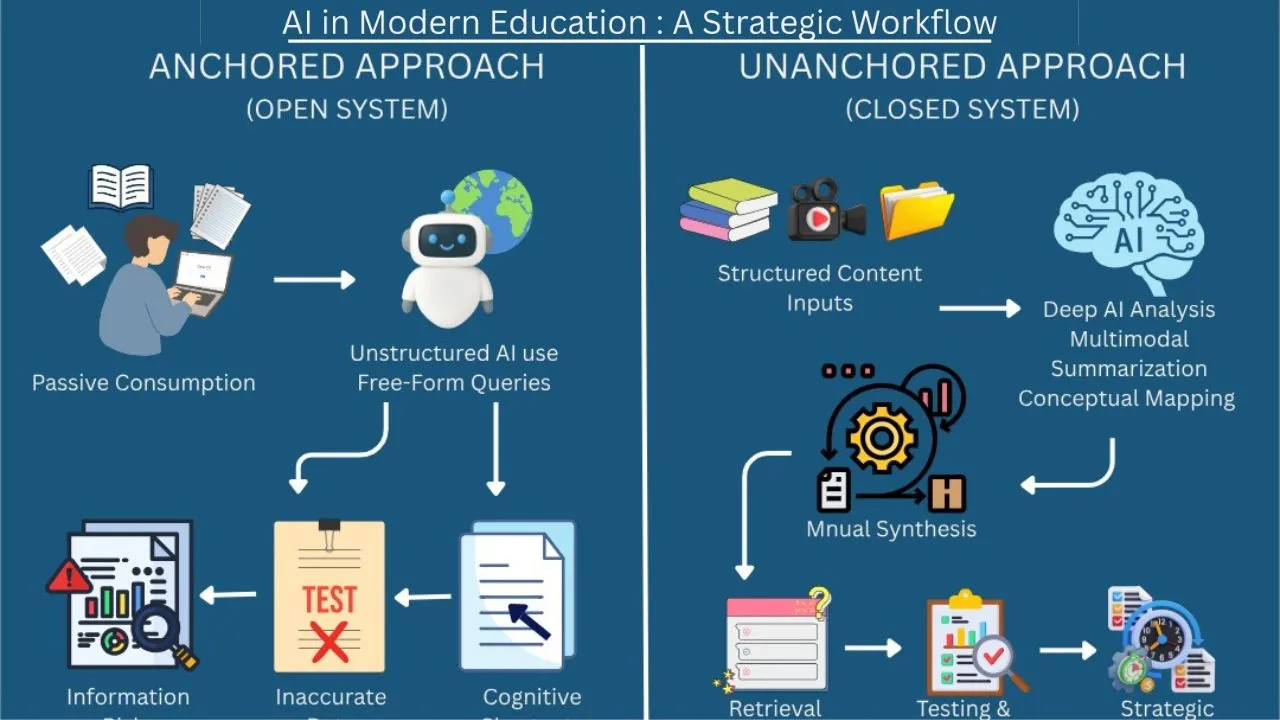
Leveraging Artificial Intelligence for Improved Educational Outcomes
This article analyses the role of Artificial Intelligence (AI) in modern teaching, moving from general use to specialized tools. It covers strategies for active learning, compares leading educational AI platforms, and outlines the implementation framework for CodeFrameAI. The main goal is to provide learners and educators with a clear method to use AI to improve understanding, retention, and exam readiness while keeping cognitive rigor.
I. General Methodologies for AI-Integrated Study
AI should be seen as a 'smart tutor' instead of a shortcut. The following steps define effective AI use:
- Active Reading and Conceptual Explanation: Users should input complex texts to get simplified explanations. This helps bridge the gap between technical language and basic understanding by connecting new topics to prior knowledge.
- Multimodal Note Generation: AI acts as a synthesizer for different data types, such as lecture notes, PDFs, and YouTube transcripts. The focus is on creating concise summaries and mind maps.
- Multilingual learning support: Users see this as a necessary part of any platform.
- Retrieval Practice via Flashcards and Quizzes: By moving from passive reading to active recall, AI changes source material into Term/Definition pairs or Multiple Choice Questions (MCQs), providing instant feedback and error correction.
- Strategic Time Boxing: AI works as a planner, breaking large syllabi into manageable units and scheduling study sessions to prevent cognitive overload.
II. Comparative Analysis of AI Study Tools (2025-2026)
Choosing a tool depends on the specific needs of learners. The following table summarizes the current market:
| Tool | Strengths | Weaknesses |
|---|---|---|
| ChatGPT/Gemini | Good for free-form tutoring and general problem-solving | May give inaccurate answers and lacks built-in study structures like flashcards. |
| StudyPDF | Best for organizing large documents and spaced repetition | Limited by mobile development. |
| StudyFetch | Great at turning slide decks and videos into study sets | Lacks advanced visual mapping. |
| Knowt | A budget-friendly option for flashcards and timetable integration | Lacks advanced AI features. |
| CodeFrameAI | A specialized AI native cross lingual platform for deep thematic content analysis, multimodal (Video, audio, PDF text files, images) use, interactive mindmaps, iQuery and Quiz options and structured grounded reports creation. | - |
| Mindgrasp | Focused on class recording and quick summarization | Limited free tier. |
III. Implementation Framework:
The implementation depends on the profile of the user e.g. a student may use it converting dense academic content into exam-ready materials, while a researcher may use it to upload multiple research reports for paper review.
The suggested generalised workflow includes:
- Structural Content Decomposition: Users uploads content to create thematic notes and specific query responses. This forms a study framework where learners can test themselves on specific topics to ensure insightful understanding.
- Multimedia Conversion: By processing audio or video transcripts for analysis, AI tools pull out key concepts, definitions and relationships. This creates a 'closed-loop' learning environment where users can interact with the content for better analysis, understanding and retention.
- Visual Cognition: Creating mind maps helps learners see how concepts connect. A key recommendation is to redraw these AI-generated maps by hand to boost memory through active learning.
- Automated Question Banks: “Closed system” product like CodeFrameAI allow the creation of multiple question sets with varying difficulty levels in real time. This supports on demand practice sessions that mimic real exam conditions, followed by AI assisted reviews and improvement.
In the AI World, it is primarily incumbent on the users to use AI responsibly. We can use AI for pre-summaries (before reading), addressing questions (during), and reviewing (after). Educators could use applications like CodeFrameAI to produce structured thematic outlines and various question types from core curriculum to provide students with standardized study tools.
AI works best as cognitive support. Closed platforms like CodeFrameAI can be used reliably for analysis due to their focus on specific source materials – this avoids hallucination which is major risk with open LLM systems like ChatGPT, Gemini, etc.
In summary, the best policy is to combine visual and manual study techniques with AI results to boost long-term retention. Careful monitoring of AI outputs is required to reduce the chances of inaccuracies, especially in free-form models like ChatGPT.