
The Transformation of Research: A Guide to Specialized AI Tools for Research
The Shift in Academic Workflows
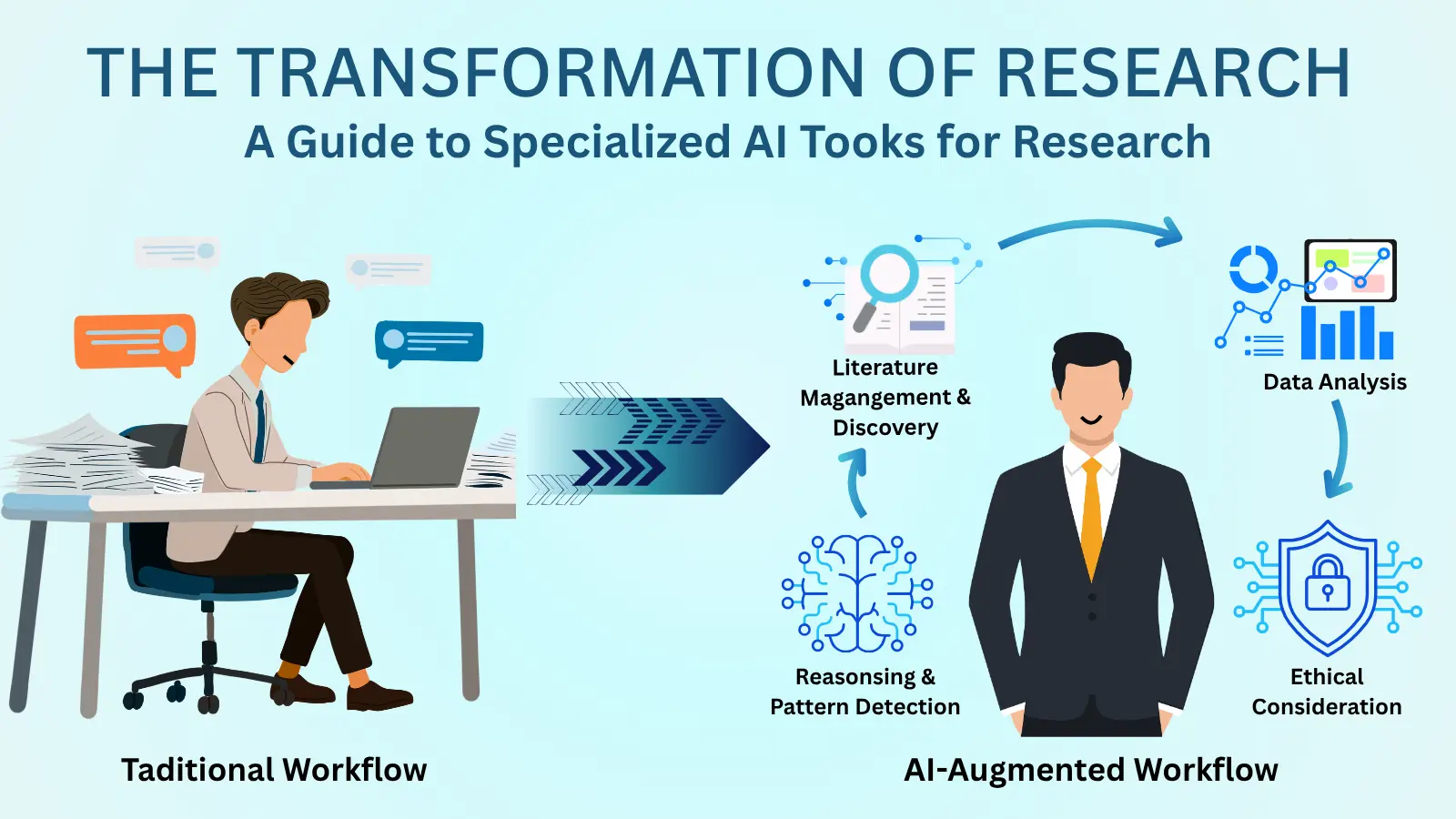
Academic research is changing as artificial intelligence (AI) becomes part of every stage of the scholarly process. Research has moved from time-consuming manual tasks to a specialized environment where AI-powered assistants use Natural Language Processing (NLP) and Machine Learning (ML) to gather information. These tools do not replace human researchers; instead, they are valuable assistants that handle repetitive tasks. This allows scholars to concentrate on higher-level interpretation and strategic organization.
What is the Best AI Tool for Research?
There is no single "best" AI tool; the right choice depends on the research stage and specific task. The following categories highlight the top-performing tools:
- For Literature Discovery and Verification: Scite stands out for its "Smart Citations," which let researchers see if a paper is supported or disputed. Research Rabbit and Litmaps are best for visualizing citation networks and tracking how ideas evolve across studies.
- For Literature Review: CodeframeAI enables thematic analysis summaries, interactive mind maps, quiz generation, advanced iQuery capabilities, semantic gap analysis, and multilingual voice-over support in 38+ languages.
- For Literature Synthesis: Elicit and Consensus are the top platforms. Elicit excels at extracting key claims into organized tables, while Consensus offers evidence-based answers directly from peer-reviewed literature.
- For Data-Focused Research: Julius AI is a leading tool for working with structured datasets, enabling analysis through natural language queries.
- For Qualitative Depth: CodeframeAI, NVivo, and ATLAS.ti are the academic standards for maintaining rigor with transparent AI-assisted coding.
- For Writing and Editing: Paperpal is designed for academic tone and journal submission requirements, performing better than general tools in clarity checks.
How AI Tools Help with Data Analysis in Research?
AI tools support researchers by spotting patterns and relationships within large datasets that would be hard to find manually. AI's role in data analysis separates into quantitative and qualitative methods:
1. Quantitative Data Analysis
Tools like Julius AI change quantitative workflows by allowing researchers to connect databases or Google Sheets and perform analysis using natural language instead of complex code. It can create histograms, box plots, and bar charts instantly. AI also helps identify outliers early and can recognize trends or relationships within large datasets, aiding early-stage exploratory visuals.
2. Qualitative Data Analysis
For unstructured data, such as interviews and focus groups, tools like NVivo, CodeframeAI, and ATLAS.ti provide essential support. These tools use AI to:
- Propose initial codes and group similar text segments.
- Conduct sentiment analysis and thematic synthesis.
- Create visual knowledge representations, like mind maps.
Crucially, tools like CodeframeAI and NVivo avoid the "black box" risk by ensuring AI-assisted sub-coding stays connected to the source data, allowing researchers to keep analytical control.
Can AI Tools Handle Statistical Questions in Research?
AI tools can address statistical questions to some degree, though they often work alongside traditional software. Julius AI can answer questions about patterns, comparisons, or differences between segments, providing metrics like averages, spreads, or distributions. Additionally, SciSpace helps break down statistical terms and research design details within complex PDF documents, aiding researchers in understanding intricate methods. CodeframeAI is unique for generating network diagrams that show, associativity, frequency and relationships between the themes.
However, for complex statistical modeling, SPSS and R are still the industry standards. While AI tools offer quick analysis and exploratory visuals, it's important to note that general-purpose AI models can suffer from "hallucinations," and make mistakes, such as inventing citations or misusing specialized terms. Thus, while AI can manage initial statistical inquiries and organize data, human oversight is necessary to ensure methodological intent and accuracy.
Balanced Perspective and Ethical Considerations
While AI tools provide significant efficiencies; they also pose important challenges. The data indicates risks such as privacy issues (especially with GDPR compliance for sensitive interview data) and a lack of source attribution. Many generic tools offer summaries without clear links to original texts. To uphold academic integrity, researchers should treat AI-generated insights as starting points rather than final conclusions and thoroughly fact-check all outputs against reliable, peer-reviewed sources.
Conclusion
The best research strategy involves a combined approach that uses specialized tools like Scite for verification, Julius AI for data visualization, and CodeframeAI for careful review and qualitative analysis. By implementing these AI-driven solutions, researchers can increase their productivity while ensuring that their results are both defensible and accurate.